
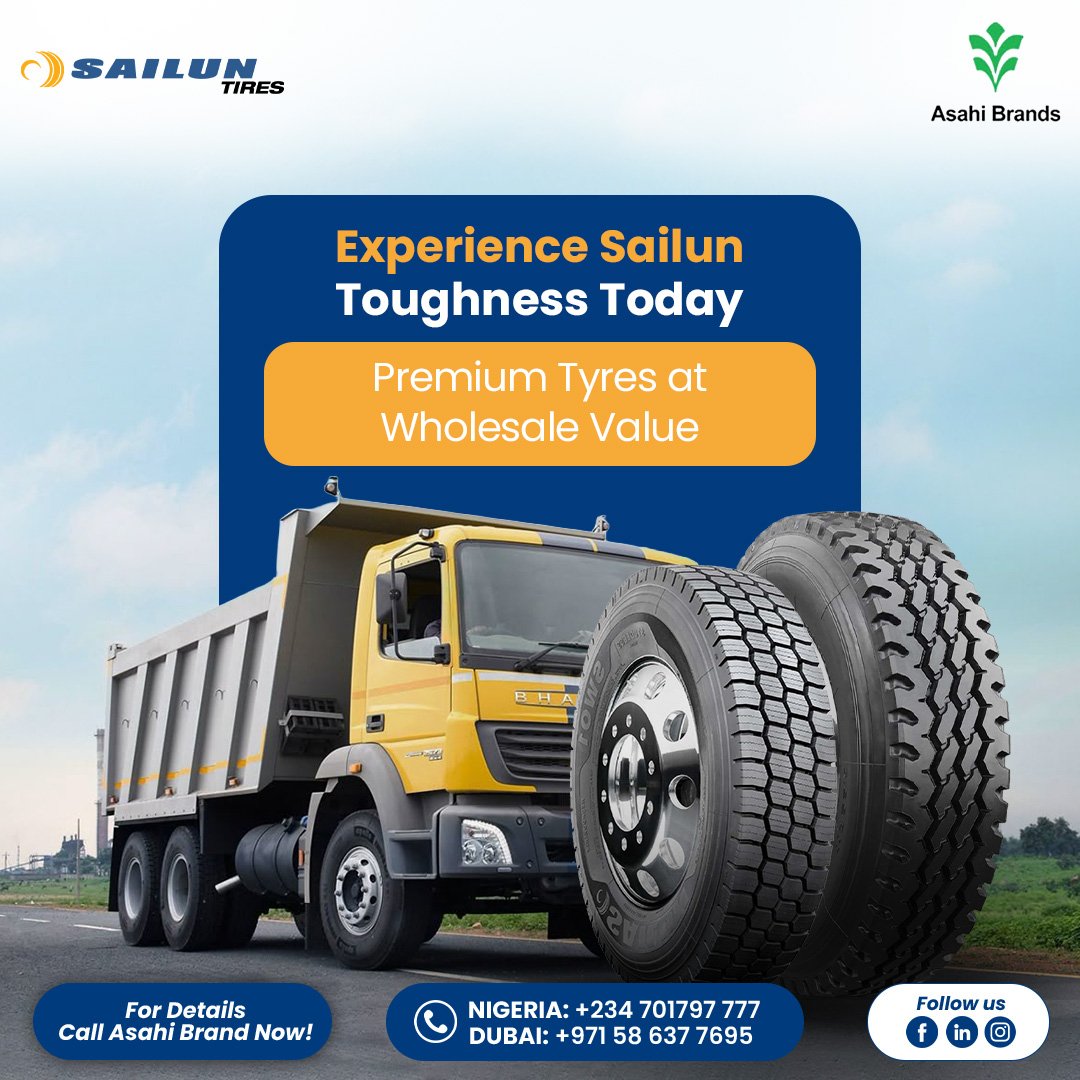
How Sailun Tyres Minimise Vehicle Downtime for Nigerian Fleets?
For logistics companies and fleet operators across Nigeria, there is one metric that quietly dictates profitability more than almost any other: vehicle uptime. Every hour a delivery van, haulage truck, or company car spends parked in a workshop instead of on the road represents lost revenue, missed delivery windows, and strained customer relationships. And among the many factors that contribute to unplanned downtime, tyre-related issues remain one of the most frequent and most preventable.
This is a conversation that matters deeply for fleet managers, logistics companies, and transport business owners operating in Nigeria's demanding commercial environment. Unlike private motorists who might drive a few kilometres a day, commercial fleets often log hundreds of kilometres daily, across varied terrain, carrying significant loads, and operating on tight schedules where a single flat tyre or premature tyre failure can cascade into missed deliveries and dissatisfied clients.
Sailun Tyres, distributed in Nigeria by Asahi Brands Limited, have increasingly become part of the conversation among fleet operators looking to reduce this specific category of operational risk. Built around a philosophy of durability, consistency, and long-term reliability, Sailun's product range is designed to hold up under the exact kind of sustained, heavy-duty use that defines commercial fleet operations in Nigeria.
This article takes a closer look at vehicle downtime as an operational challenge, breaks down the specific ways tyre failure contributes to it, and explains how Sailun Tyres are engineered to help logistics companies and fleet managers keep their vehicles where they belong: on the road, generating revenue.
Consider a mid-sized last-mile delivery operation running twenty vans across Lagos. If just two of those vans are pulled off the road each week due to preventable tyre issues, the cumulative annual impact on delivery capacity, driver scheduling, and client satisfaction can be substantial. Scale that scenario across the many transport companies, courier services, and haulage operators working throughout Nigeria, and the case for treating tyre selection as a strategic procurement decision, rather than a routine purchase, becomes clear.
Understanding the Problem
The True Cost of Downtime
When a commercial vehicle is taken off the road due to a tyre issue, the visible cost is often just the price of a replacement tyre or repair. The invisible costs, however, tend to be far larger. These include lost delivery revenue, penalty clauses in service level agreements, driver idle time, rescheduling costs, and in some cases, reputational damage with clients who depend on predictable service.
Frequent Tyre Replacement in Commercial Use
Commercial vehicles typically experience faster tyre wear than private vehicles due to heavier loads, longer daily distances, and more frequent stop-start driving in urban delivery routes. Fleet operators using lower-quality tyres often find themselves replacing tyres at a pace that erodes profit margins significantly over a fiscal year.
Poor Grip Increases Accident Risk
For fleets, an accident does not just mean vehicle repair costs. It can mean cargo damage, insurance claims, driver injury, and extended vehicle downtime while investigations and repairs take place. Tyres with subpar wet or dry grip elevate this risk considerably, particularly for vehicles that operate during Nigeria's unpredictable rainy season.
Rapid Wear from Rough Roads
Delivery routes frequently include stretches of poorly maintained roads, especially in areas outside Nigeria's major highways. This kind of terrain accelerates tread wear and increases the likelihood of sidewall damage, both of which can force a vehicle out of service unexpectedly.
High Fuel Consumption Across a Fleet
Fuel is one of the highest recurring costs for any transport business. Multiplied across an entire fleet, even a small increase in rolling resistance per vehicle can translate into a substantial rise in monthly fuel expenditure, directly impacting profitability.
Heat-Related Tyre Stress on Long Routes
Long-haul commercial routes expose tyres to sustained heat build-up, particularly during Nigeria's hotter months. This heat stress can accelerate internal degradation, increasing the risk of blowouts on routes where roadside assistance may not be readily available.
Fleet Operating Costs and Long-Distance Transportation Demands
Combining all of the above, it becomes clear that tyre-related issues are not an isolated cost centre; they are woven into nearly every aspect of fleet operating expenses, from fuel and maintenance budgets to insurance premiums and staff scheduling.
The Ripple Effect on Scheduling and Client Trust
Beyond the direct financial cost, there is a scheduling ripple effect that many fleet managers know all too well. A single vehicle sidelined by a tyre failure often requires reallocating deliveries to other vehicles, adjusting driver routes at short notice, and in some cases, informing clients of delays. Over time, repeated incidents of this nature can quietly erode client trust, even if each individual delay seems minor in isolation. For businesses competing on reliability and speed, this is a risk that compounds silently until it becomes a visible pattern that clients start to notice and remember.
How Sailun Tyres Help
Built-In Durability for Extended Service Life
Sailun Tyres are engineered with reinforced construction designed to withstand the heavier loads and longer daily distances typical of commercial fleet operations. This directly addresses the problem of frequent, unplanned replacements, allowing fleet managers to plan tyre replacement cycles more predictably rather than reactively.
Safety Improvements Through Consistent Grip
By maintaining strong grip performance across both wet and dry conditions, Sailun Tyres help reduce the accident risk associated with poor traction, a factor that directly protects both drivers and cargo while minimising the downtime associated with post-accident vehicle repairs.
Fuel-Saving Capabilities Across the Fleet
Reduced rolling resistance is not just a marginal benefit for an individual vehicle; when applied across an entire fleet, it can meaningfully lower overall fuel expenditure. For logistics companies operating on thin margins, this kind of consistent, fleet-wide saving can make a measurable difference to the bottom line.
High Mileage Performance for Predictable Planning
One of the more understated benefits of high-mileage tyres is the predictability they bring to fleet maintenance scheduling. When tyres last longer and wear more evenly, fleet managers can plan replacement cycles with greater confidence, reducing the likelihood of surprise workshop visits that pull vehicles out of active rotation unexpectedly.
Reliability Advantages on Long-Haul Routes
For fleets running long-distance routes, Sailun's approach to heat management and structural resilience is designed to reduce the risk of tyre failure mid-journey, a critical consideration for routes where breakdown assistance may be limited or delayed.
Commercial Benefits Beyond the Tyre Itself
Ultimately, the cumulative effect of these features is a fleet that spends less time in the workshop and more time generating revenue on the road, which is the single most important operational outcome for any logistics or transport business.
An Illustrative Scenario
Picture two similarly sized delivery fleets operating in Lagos, each running twenty-five vans on comparable routes. One fleet uses tyres selected primarily on upfront cost, with little regard for long-term durability. The other standardises on Sailun Tyres, prioritising consistent performance and mileage life. Over twelve months, the second fleet is likely to experience fewer unplanned workshop visits, more predictable tyre replacement cycles that can be budgeted for in advance, and a lower overall spend per kilometre once fuel savings and reduced downtime are factored in. While actual results will always depend on route conditions, driver behaviour, and vehicle maintenance practices, this kind of scenario illustrates why an increasing number of Nigerian fleet operators are shifting their tyre procurement strategy away from short-term cost thinking and toward long-term operational value.
Top Features of Sailun Tyres
- Advanced tyre technology built on continuous engineering research
- Long tyre life that supports predictable fleet maintenance planning
- Excellent wet and dry grip for safer commercial driving
- Improved fuel efficiency across large vehicle fleets
- Reduced rolling resistance that lowers per-vehicle fuel costs
- Enhanced ride comfort for drivers covering long daily distances
- Reliable braking performance under heavy commercial loads
- Durable construction suited to demanding delivery and haulage routes
- High mileage potential that reduces total fleet tyre spend
- Fleet-friendly performance across varied vehicle types
- Commercial vehicle suitability for trucks, vans, and buses
- Strong road handling under variable load conditions
- Consistent performance across different drivers and routes
- Value-driven ownership that supports long-term fleet budgeting
- Smart Performance Technology applied across the commercial tyre range
Why Sailun Tyres Are Popular in Nigeria
Fleet operators across Nigeria have increasingly gravitated toward Sailun Tyres precisely because the brand's value proposition aligns so closely with the operational realities of commercial transport. Unlike private car owners who might prioritise aesthetics or brand prestige, fleet managers are driven almost entirely by measurable outcomes: cost per kilometre, downtime frequency, and total cost of ownership.
This growing market demand has been particularly visible among logistics companies managing delivery fleets across Lagos and other major commercial hubs, where daily mileage and vehicle utilisation rates are exceptionally high. For these operators, a tyre brand that consistently delivers on its durability and reliability promises quickly earns a reputation within the industry, often spreading through direct operator networks and fleet management associations.
Commercial vehicle applications have also expanded Sailun's footprint, with transport businesses operating everything from mid-sized delivery vans to heavier haulage trucks finding value in a single tyre brand capable of serving multiple vehicle categories within their fleet, simplifying procurement and maintenance planning in the process.
The value-driven performance that Sailun offers, combined with proven reliability on Nigeria's often challenging road network, has positioned the brand as a serious contender for fleet operators who have grown weary of tyres that promise much but deliver inconsistent real-world results. Long-term ownership benefits, particularly around reduced total cost of ownership, continue to reinforce this trend as more operators track and share performance data internally.
Fleet management as a discipline has also matured considerably in Nigeria over recent years, with more operators adopting structured maintenance tracking, cost-per-kilometre analysis, and vendor performance reviews. As this level of operational rigour becomes more common, tyre brands are increasingly evaluated on hard data rather than reputation alone, and it is within this more analytical purchasing environment that Sailun's consistent, measurable performance has helped the brand gain steady traction among Nigeria's more sophisticated fleet operators.
Why Buy from Asahi Brands
For fleet operators, the decision of where to source tyres is arguably just as important as the tyre brand itself. Asahi Brands Limited, as a trusted importer and distributor of genuine Sailun Tyres in Nigeria, offers fleet managers a level of assurance that is difficult to replicate through informal or unverified supply channels.
Given the scale at which fleets operate, purchasing counterfeit or substandard tyres is not just a safety risk; it is a significant financial risk, given how frequently such tyres need replacing and how much unplanned downtime they can generate. Working with an established distributor like Asahi Brands substantially reduces this risk, ensuring that every tyre installed across a fleet meets consistent quality standards.
Asahi Brands also brings valuable industry expertise to fleet procurement conversations, helping operators select appropriate tyre specifications based on vehicle type, typical route conditions, and load requirements. This kind of tailored guidance can meaningfully improve fleet performance outcomes compared to generic, one-size-fits-all purchasing decisions.
Reliable customer support and nationwide supply capability further strengthen the case for fleet operators working with Asahi Brands, particularly for companies operating vehicles across multiple regions of Nigeria, where consistent product availability across locations is essential for maintaining smooth fleet operations without unexpected supply gaps.
For fleet managers responsible for large procurement decisions, the relationship with a tyre distributor is often ongoing rather than transactional, involving repeat orders, bulk supply arrangements, and periodic consultation as fleet composition changes over time. Asahi Brands' positioning as an established, long-term automotive distributor, rather than a short-term reseller, makes it well suited to support this kind of sustained business relationship, giving fleet operators confidence that their tyre supply needs will continue to be met consistently as their operations grow.
Frequently Asked Questions for Fleet Managers
How can tyre choice affect my fleet's overall operating budget? Tyre-related costs extend well beyond the purchase price. Replacement frequency, fuel consumption, and downtime from failures all feed directly into your fleet's operating budget, which is why choosing durable, well-engineered tyres like Sailun can produce measurable savings over a full operating year.
Are Sailun Tyres suitable for mixed fleets with different vehicle types? Yes. Sailun's product range spans passenger vehicles, SUVs, and commercial vehicles, allowing fleet operators managing a mix of vehicle types to standardise around a single trusted tyre brand, which can simplify procurement and maintenance planning considerably.
How often should fleet tyres be inspected to avoid unplanned downtime? While inspection schedules vary by vehicle usage and route conditions, regular tread and pressure checks, ideally as part of a routine maintenance schedule, help catch early warning signs before they escalate into unplanned breakdowns.
Does buying tyres through a distributor like Asahi Brands offer fleet-specific support? Yes. Asahi Brands works with fleet operators to understand specific vehicle types, typical routes, and load requirements, helping match the right tyre specification to each fleet's operational profile rather than offering a generic, one-size-fits-all recommendation.
Conclusion
Vehicle downtime is one of the quiet but persistent threats to profitability in Nigeria's logistics and transport sector. While it can stem from many sources, tyre-related failures remain among the most preventable, provided fleet operators make informed choices about the tyres they invest in.
Sailun Tyres, engineered around durability, consistent grip, fuel efficiency, and high mileage potential, offer fleet managers a meaningful way to reduce the frequency of tyre-related downtime while simultaneously lowering fuel and maintenance costs. Paired with the trusted distribution and industry expertise of Asahi Brands Limited, Nigerian fleet operators gain access to a dependable tyre solution built specifically for the demands of commercial transport.
For any logistics company or fleet manager looking to keep vehicles on the road longer and reduce the operational disruptions caused by preventable tyre issues, Sailun Tyres represent a practical, results-driven choice.
Ultimately, reducing vehicle downtime is not about eliminating every possible cause of disruption, an unrealistic goal for any fleet operating in Nigeria's varied road environment. It is about systematically removing the preventable causes, and tyre-related failures sit firmly within that category. By investing in genuine, well-engineered tyres and pairing that investment with a dependable supply partner, fleet operators put themselves in a far stronger position to protect delivery schedules, control costs, and maintain the level of service their clients expect.





Write your review
No reviews yet. Be the first to review!