
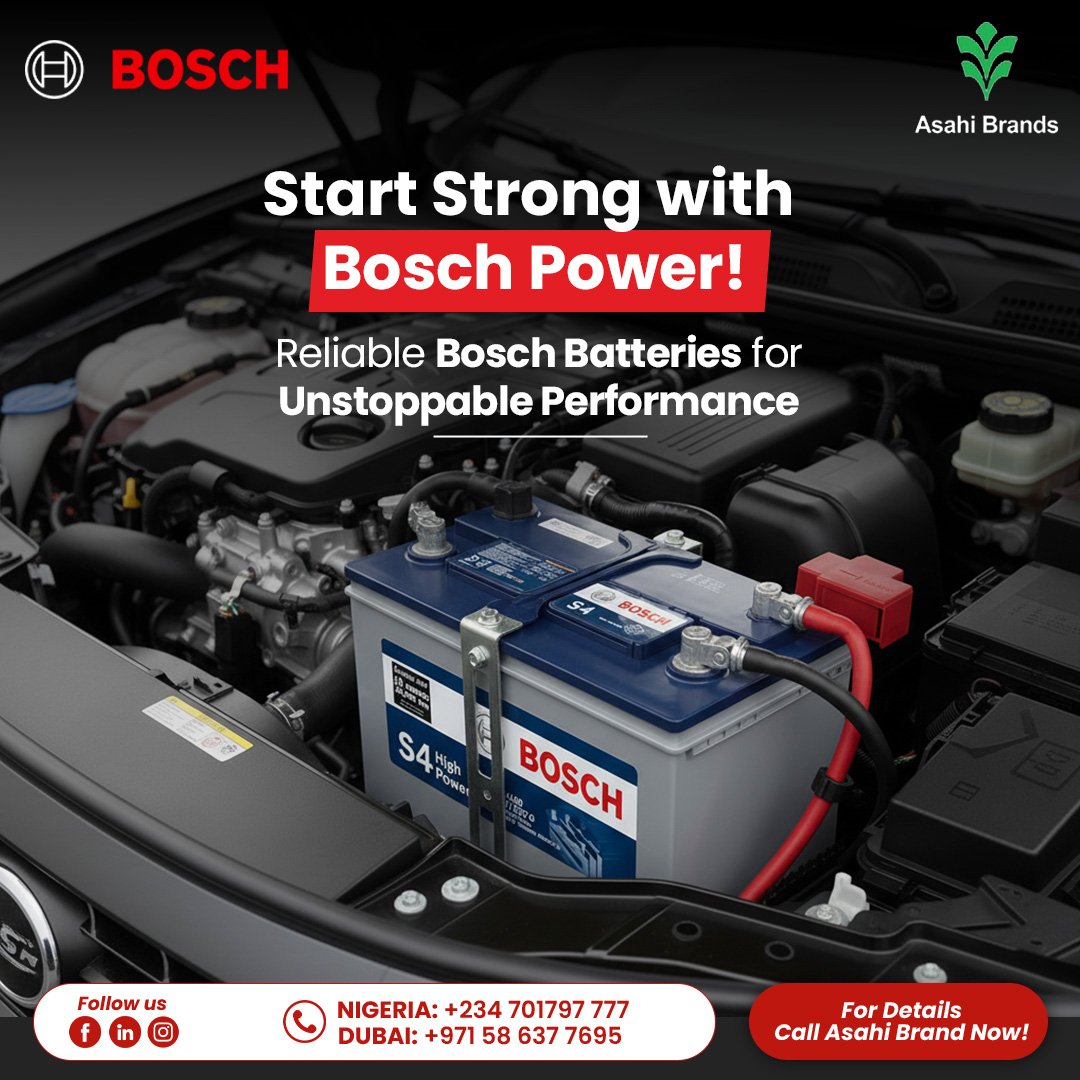
Why Won’t My Car Start? A Practical Guide to Vehicle Batteries for Nigerian Drivers and Fleet Operators
It usually happens at the worst possible moment. You turn the key or press the start button, and instead of your engine roaring to life, you hear a slow, tired clicking sound — or nothing at all. For millions of drivers across Nigeria, a dead battery is one of the most common and frustrating vehicle problems, and one that often strikes without warning.
Batteries are the unsung workhorses of every vehicle’s electrical system, quietly powering everything from the starter motor to the infotainment system, headlights, and increasingly complex onboard electronics. Yet most drivers only think about their battery once it has already failed. This guide explains, in practical terms, how vehicle batteries work, why they fail — particularly under Nigerian conditions — and what drivers, workshops, and fleet operators can do to avoid being stranded.
Throughout, we will reference genuine Bosch batteries, available through Asahi Brands Limited, a trusted supplier serving customers across Lagos and Nigeria.
The Role of the Battery: More Than Just Starting the Engine
Many drivers assume the battery’s only job is to start the engine. In reality, the battery performs several critical functions throughout every journey:
-
Supplying the burst of current needed to turn the starter motor and ignite the engine
-
Stabilising the vehicle’s electrical system, smoothing out voltage fluctuations from the alternator
-
Powering electrical components — lights, indicators, infotainment, sensors — when the engine is off or idling
-
Acting as a buffer for the increasingly sophisticated electronic control units found in modern vehicles
A battery that is weak, ageing, or incorrectly matched to the vehicle can cause problems well beyond a simple failure to start — including inconsistent electrical performance, dimming lights, and even damage to sensitive onboard electronics.
Why Batteries Fail: The Real Causes Behind Nigeria’s Battery Problems
1. Extreme Heat and Its Hidden Toll
The problem: Many drivers assume cold weather is the main enemy of car batteries — a reasonable assumption in many parts of the world, but not in Nigeria, where heat is the far greater threat.
Why it happens: High ambient temperatures accelerate the chemical reactions inside a battery, including the internal corrosion and evaporation processes that gradually degrade its capacity. A battery that might last five years in a temperate climate can have a meaningfully shorter working life under sustained tropical heat, particularly when vehicles are frequently parked in direct sun.
The consequence: Batteries degrade faster than drivers expect, often failing well before they anticipate needing a replacement.
The solution: Batteries engineered with heat-resistant internal components and robust plate construction cope significantly better with sustained high temperatures — an important consideration for any battery purchased for use in Nigeria.
2. Poor Charging System Performance
The problem: A battery that repeatedly runs low on charge, even after driving, often gets unfairly blamed as “faulty” when the real issue lies elsewhere in the vehicle’s electrical system.
Why it happens: The alternator is responsible for recharging the battery while the engine runs. If the alternator is undercharging (or overcharging) the battery, or if there are corroded terminals, loose connections, or a failing voltage regulator, the battery will never reach or maintain a healthy charge state — regardless of its own quality.
The consequence: Drivers may replace a perfectly good battery, only to find the same problem recurs shortly afterwards because the underlying charging issue was never addressed.
The solution: Whenever a battery seems to be failing prematurely, the charging system should be tested alongside the battery itself. A quality battery paired with a properly functioning charging system will deliver consistent, reliable performance.
3. Short Journeys and Stop-Start Traffic
The problem: Lagos traffic is notorious for long periods of idling and short-distance trips — conditions that are particularly hard on a vehicle’s battery.
Why it happens: Starting an engine draws a significant amount of charge from the battery. If journeys are too short, or too much time is spent idling in traffic with electrical accessories (air conditioning, lights, infotainment) running, the alternator may not have sufficient opportunity to recharge the battery fully between starts.
The consequence: Over time, the battery operates in a chronically undercharged state, which accelerates internal degradation and shortens its overall lifespan.
The solution: Where possible, allowing the vehicle to run for a reasonable, continuous period helps maintain a healthier charge cycle. Batteries designed for frequent start-stop use, increasingly common in modern vehicle design, are also better suited to this kind of driving pattern.
4. Vibration and Rough Roads
The problem: Many secondary roads across Nigeria remain unpaved or poorly maintained, subjecting vehicles — and their batteries — to significant vibration.
Why it happens: Constant vibration can loosen internal battery components over time, and in poorly secured battery mounts, physical movement can cause internal short circuits or accelerated plate wear.
The consequence: This is a particularly common, and often misunderstood, cause of premature battery failure in vehicles regularly driven on rough terrain — including many commercial and agricultural vehicles.
The solution: Batteries built with reinforced internal construction, combined with secure mounting and regular inspection of the battery tray and hold-down clamps, significantly reduce vibration-related failures.
5. Parasitic Drain from Electrical Accessories
The problem: Some drivers find their battery flat in the morning despite the vehicle running perfectly well the day before.
Why it happens: Aftermarket accessories, faulty relays, or components that do not fully power down (such as certain alarm systems, tracking devices, or infotainment units) can continue drawing a small but steady current even when the vehicle is off — a phenomenon known as parasitic drain.
The consequence: Over days or weeks, this slow drain can leave a battery unable to start the vehicle, even though the battery itself may be in good condition.
The solution: If unexplained battery drain becomes a recurring issue, a workshop can test for parasitic draws using standard diagnostic procedures, helping identify and resolve the underlying cause rather than repeatedly replacing the battery.
Recognising the Warning Signs of a Failing Battery
Batteries rarely fail without any warning at all — the signs are often present for days or weeks beforehand, even if drivers do not always recognise them:
-
Slower-than-normal engine cranking when starting
-
Dimming headlights or interior lights, particularly at idle
-
Dashboard warning lights related to the battery or charging system
-
Electrical accessories behaving inconsistently (power windows moving slowly, radio resetting)
-
A swollen or misshapen battery case
-
Visible corrosion around the battery terminals
-
A battery older than three to four years, particularly one regularly exposed to heat or short journeys
Recognising these signs early allows drivers and fleet managers to plan a replacement proactively, rather than facing an unexpected breakdown.
Battery Considerations for Commercial Vehicles and Fleets
Fleet operators face a distinct set of challenges compared to private car owners:
-
Multiple daily starts across a working fleet place cumulative strain on batteries, particularly for delivery vehicles making frequent short stops.
-
Downtime cost is far higher for a commercial vehicle than a private car — a single battery failure can delay deliveries, disrupt schedules, and affect customer commitments.
-
Standardisation across a fleet — using consistent, correctly specified batteries across similar vehicle types — simplifies maintenance planning and reduces the risk of incorrect replacements.
-
Proactive replacement scheduling, based on battery age and performance testing rather than waiting for failure, is generally more cost-effective for fleets than reactive breakdown responses.
How to Choose the Correct Battery
Selecting the right battery involves more than simply matching physical size. Consider:
-
Cold cranking amps (CCA): Indicates the battery’s ability to deliver a strong starting current — particularly relevant for larger engines or vehicles with significant electrical loads.
-
Reserve capacity: Reflects how long the battery can power essential systems if the alternator fails or is insufficient, offering a safety margin in real-world driving.
-
Correct group size and terminal configuration: Ensures a proper physical and electrical fit for your specific vehicle.
-
Manufacture date: Batteries degrade even in storage, so checking how recently a battery was manufactured is a useful, often overlooked step.
-
Application suitability: Vehicles with extensive electronics, or commercial vehicles with heavy accessory loads, may require batteries specifically designed for higher electrical demand.
Practical Battery Maintenance Advice
-
Check terminals regularly for corrosion and clean them if a white or bluish residue appears, as this increases electrical resistance and reduces starting performance.
-
Ensure the battery is securely mounted, minimising vibration-related damage, particularly for vehicles regularly driven on rough roads.
-
Avoid running electrical accessories for extended periods with the engine off, as this accelerates discharge.
-
Have the charging system tested periodically, not just the battery itself, particularly if starting performance seems inconsistent.
-
Park in shade where possible, reducing the cumulative heat exposure that shortens battery lifespan in Nigeria’s climate.
-
Test battery health proactively before long journeys, particularly for vehicles travelling significant distances between cities.
Frequently Asked Questions
How long should a car battery last in Nigeria? This varies depending on usage patterns, heat exposure, and vehicle electrical demand, but Nigeria’s climate generally shortens battery lifespan compared to cooler regions, making proactive monitoring particularly important.
Can I jump-start my vehicle if the battery is completely dead? In most cases, yes, provided the battery itself is not physically damaged, but repeated jump-starting without addressing the underlying cause of discharge is not a long-term solution.
Is it normal for a new battery to fail within a year? No, while rare manufacturing issues can occur, premature failure of a genuinely new battery more commonly points to a charging system fault, parasitic drain, or installation issue that should be investigated.
Do commercial vehicles need different batteries from private cars? Often yes, particularly for vehicles with higher electrical demands, frequent start-stop cycles, or larger engines requiring greater cranking power.
How can I tell if a battery is genuine? Genuine batteries carry consistent, clear branding and markings, and should be purchased from an established, reputable supplier who can confirm the product’s authenticity and origin.
Why Choose Asahi Brands Limited?
A battery is only as reliable as the source it comes from. Asahi Brands Limited, based at 122–132, Oshodi Apapa Expressway, Isolo, Lagos, operates as a trusted importer, national distributor, wholesale supplier, and retail supplier of genuine automotive and industrial products across Nigeria.
For private drivers, workshops, and fleet operators alike, Asahi Brands offers:
-
Genuine, internationally recognised battery brands suited to Nigeria’s demanding climate
-
Wholesale and retail supply options for individual customers and large commercial accounts
-
Dedicated fleet solutions to help commercial and logistics operators manage battery replacement proactively
-
Nationwide supply across Nigeria, ensuring availability wherever customers are based
-
Competitive pricing without compromising on product authenticity
-
Reliable stock availability reduces the risk of extended vehicle downtime
-
Genuine industry expertise, helping customers select the correctly specified battery for their vehicle and usage pattern
-
A customer-focused approach built around long-term reliability, not just a single sale
Asahi Brands Limited is not the manufacturer of the batteries it supplies; its role is to serve as a dependable, knowledgeable channel connecting Nigerian customers with genuine, internationally manufactured Bosch batteries.
Visit https://www.asahibrands.com to explore the full battery range.
Conclusion
A vehicle’s battery works quietly in the background until the day it doesn’t — and in Nigeria’s climate, with its combination of intense heat, stop-start traffic, and challenging road conditions, batteries face a genuinely tough working environment. Understanding why batteries fail, recognising the early warning signs, and choosing a genuine, correctly specified battery are the most effective ways to avoid being stranded and to protect the broader electrical health of your vehicle.
Don’t wait for a dead battery to catch you off guard. Contact Asahi Brands Limited in Lagos today, or visit https://www.asahibrands.com to find the right genuine Bosch battery for your vehicle or fleet.





Write your review
No reviews yet. Be the first to review!