
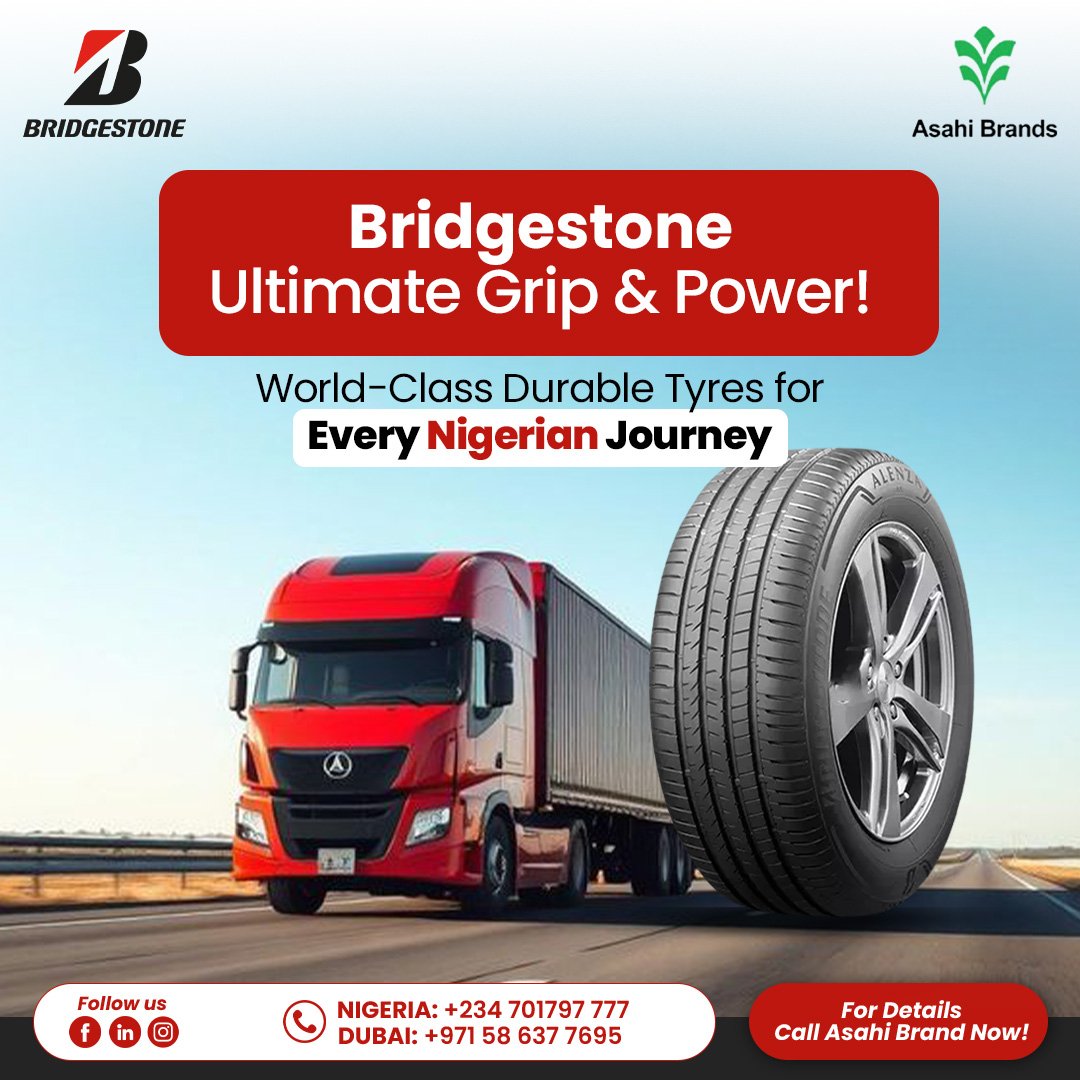
Bridgestone Tyres in Nigeria: The Complete Guide to Safer, Smarter Driving on Lagos Roads
Every journey on Nigerian roads starts and ends with four small contact patches of rubber touching the tarmac. Whether you are navigating the Lagos-Ibadan Expressway during rush hour, hauling goods along the Apapa corridor, or driving your family across town on a rainy evening, your tyres are the single most important safety component on your vehicle. Yet tyres remain one of the most overlooked and misunderstood parts of vehicle ownership in Nigeria.
This guide takes an in-depth look at Bridgestone tyres and what they mean for passenger car owners, SUV drivers, truck operators, and fleet managers across Lagos and the wider Nigerian market. Rather than simply listing specifications, we will explore the real problems Nigerian drivers face on the road, why they happen, and how choosing the right tyres — sourced from a trusted supplier such as Asahi Brands Limited — can make a measurable difference to safety, cost, and vehicle performance.
Why Tyres Deserve More Attention Than They Get
Most vehicle owners think about engine oil, brake pads, or air conditioning long before they think about tyres. This is understandable — tyres are not glamorous, and unless there is an obvious puncture or visible wear, they tend to be ignored until something goes wrong.
The problem is that tyre failure rarely gives much warning. A slow puncture, gradual tread wear, or an ageing sidewall can all lead to sudden blowouts, loss of control, or extended braking distances at exactly the wrong moment — often at highway speed or in heavy rain. In a country where a large share of road travel happens on expressways shared by buses, articulated trucks, motorcycles, and private cars all moving at different speeds, the margin for error is small.
Understanding how tyres work, what affects their performance, and how to choose correctly is not a luxury — it is a practical necessity for anyone who drives or manages vehicles in Nigeria.
Common Tyre-Related Problems Nigerian Drivers Face
1. Poor Grip in Wet Conditions
Nigeria’s rainy season, which can run for several months depending on the region, turns ordinary road hazards into serious risks. Standing water, oily patches near fuel stations, and poorly drained sections of road all reduce the contact between tyre and tarmac.
Why it happens: Worn tread patterns lose their ability to channel water away from the contact patch. This leads to aquaplaning, where a thin layer of water lifts the tyre off the road surface, causing the driver to lose steering and braking control briefly.
The consequence: Aquaplaning is one of the leading causes of loss-of-control accidents during heavy rainfall. Even experienced drivers cannot fully compensate for a tyre that has lost contact with the road.
The solution: Tyres with deep, well-engineered tread patterns and wide circumferential grooves are specifically designed to disperse water quickly. This is one of the areas where Bridgestone’s tread engineering is particularly relevant for Nigerian conditions, where sudden downpours are common even during the dry season.
2. Overheating on Long Highway Journeys
Nigeria’s climate, particularly in the northern and middle-belt regions, combines high ambient temperatures with long, uninterrupted highway stretches. Combine this with underinflated tyres or excessive load, and internal tyre temperatures can rise significantly.
Why it happens: As a tyre flexes repeatedly under load, friction generates heat. Underinflation increases this flexing, and higher ambient temperatures compound the effect. Once internal temperatures pass a critical threshold, the tyre’s internal structure can begin to degrade rapidly.
The consequence: Heat build-up is a major contributor to sudden blowouts on highways — precisely the type of failure that leads to serious accidents at speed.
The solution: Tyres engineered with heat-resistant compounds and reinforced casings cope better with sustained highway use. Regular pressure checks (discussed later in this guide) are equally important, as correct inflation is one of the simplest ways to manage heat build-up.
3. Uneven and Premature Tread Wear
Many Nigerian drivers notice that their tyres wear out faster on one side, or develop patchy wear patterns, long before the tyre reaches the end of its expected lifespan.
Why it happens: This is usually caused by a combination of factors: poor wheel alignment (often the result of hitting potholes, which remain common on many secondary roads), incorrect tyre pressure, or carrying loads that exceed the vehicle’s rated capacity.
The consequence: Uneven wear reduces the effective lifespan of a tyre, meaning drivers pay for replacements more frequently. It can also affect handling, making the vehicle pull to one side or feel unstable during braking.
The solution: Periodic wheel alignment checks, correct load management, and tyres built with robust, evenly wearing tread compounds all help extend usable tyre life.
4. Braking Distance in Emergency Situations
Lagos traffic is unpredictable. Okada riders weave between lanes, pedestrians cross at unexpected points, and sudden stops are a daily occurrence. In these situations, the difference between a controlled stop and a collision often comes down to a few metres of braking distance.
Why it happens: Braking performance depends heavily on tread design and rubber compound. A worn or low-quality tyre cannot generate the same friction as a tyre with fresh, well-designed tread — regardless of how good the vehicle’s brakes are.
The consequence: Extended braking distances increase the likelihood of rear-end collisions, particularly in dense urban traffic.
The solution: Tyres engineered for strong braking performance, combined with regular tread depth checks, give drivers a meaningful safety margin in emergencies.
5. Counterfeit and Substandard Tyres
Perhaps the most serious — and least discussed — problem in the Nigerian tyre market is the circulation of counterfeit, mislabelled, or improperly aged tyres.
Why it happens: Because tyres are a high-value, frequently replaced item, some unscrupulous suppliers import used or rejected tyres, or sell products that fraudulently carry recognised brand names without any of the underlying engineering or quality control.
The consequence: Counterfeit tyres often fail without warning. They may look acceptable on the surface but lack the internal reinforcement, correct rubber compounds, or structural integrity needed to perform safely — particularly under Nigerian conditions of heat, load, and rough roads.
The solution: The only reliable protection against counterfeit tyres is buying from an established, reputable supplier that sources genuine products directly through recognised import channels. This is precisely the role Asahi Brands Limited plays for customers across Nigeria.
Understanding Tyre Categories: Matching the Tyre to the Vehicle
Passenger Car Tyres
For everyday sedans and hatchbacks, the priorities are comfort, fuel efficiency, low road noise, and dependable wet-weather grip. Most private car owners in Lagos are driving in stop-start traffic for a significant portion of their journeys, so tyres that resist wear under constant braking and acceleration cycles offer real long-term value.
SUV Tyres
SUVs carry more weight and are frequently driven on a mix of paved roads and rougher terrain, including estate roads, construction sites, or rural routes outside major cities. SUV tyres need reinforced sidewalls to resist impact damage and a tread pattern that balances on-road comfort with a degree of off-road capability.
Truck and Commercial Vehicle Tyres
Commercial operators — logistics companies, haulage firms, and transport businesses — have very different priorities. Load-carrying capacity, resistance to heat build-up over long distances, and total cost per kilometre driven (rather than simply the upfront purchase price) matter far more than comfort. A tyre that lasts an additional 15,000 to 20,000 kilometres before replacement can have a meaningful impact on a fleet’s operating budget.
Key Tyre Performance Factors Explained
It is not enough to know that a tyre has certain “features” — what matters is understanding what those features actually do for the driver.
-
Tread pattern design: Determines how effectively water, mud, and debris are channelled away from the contact patch. A well-designed pattern is the difference between confident cornering in the rain and a dangerous loss of grip.
-
Rubber compound: Affects the balance between grip and durability. Softer compounds generally grip better but wear faster; harder compounds last longer but may offer less traction in wet conditions. The engineering challenge is balancing both without sacrificing safety.
-
Sidewall construction: A reinforced sidewall resists damage from potholes and kerbs — a genuinely important consideration on many Nigerian roads — while still providing a comfortable ride.
-
Load index and speed rating: These figures indicate the maximum weight a tyre can safely carry and the maximum speed at which it can perform safely. Using a tyre with an inadequate load index for a fully loaded commercial vehicle is a common and dangerous mistake.
-
Fuel efficiency (rolling resistance): Lower rolling resistance means the engine uses less energy to keep the vehicle moving, which translates directly into fuel savings — a significant consideration for fleet operators managing dozens or hundreds of vehicles.
Practical Tyre Maintenance Advice for Nigerian Conditions
-
Check tyre pressure monthly, and always before long journeys. Heat and rough roads accelerate pressure loss. Underinflated tyres wear unevenly, generate excess heat, and increase fuel consumption.
-
Inspect tread depth regularly. A simple visual check for wear indicators built into the tread grooves can alert you to a tyre approaching the end of its safe life.
-
Rotate tyres periodically. This helps ensure even wear across all four tyres, extending overall lifespan.
-
Have wheel alignment checked after hitting significant potholes. Given the state of some secondary roads, a single hard impact can knock alignment out, leading to accelerated and uneven wear.
-
Avoid overloading. Commercial and passenger vehicles alike should stay within their rated load capacity — exceeding it places excessive stress on tyres, regardless of how well-engineered they are.
-
Store spare tyres correctly. Heat and direct sunlight degrade rubber over time, even on tyres that are never driven on.
How to Choose the Right Bridgestone Tyre
When selecting tyres, consider the following:
-
Vehicle type and typical use — city driving, highway travel, or a mix of both.
-
Load requirements — particularly important for commercial and fleet vehicles.
-
Climate and road conditions on your typical routes.
-
Budget versus total cost of ownership — a slightly higher upfront cost is often offset by longer tread life and better fuel efficiency.
-
Source of purchase — always buy from a supplier who can confirm the authenticity and origin of the product.
Frequently Asked Questions
How often should I replace my tyres? Most tyres should be assessed for replacement once tread depth approaches the legal or safety minimum, or every few years, regardless of tread depth, as rubber compounds degrade with age and heat exposure, even on tyres that are rarely used.
Can I mix different tyre brands on the same vehicle? It is generally best to avoid mixing brands or tread patterns on the same axle, as this can cause inconsistent handling, particularly during braking or cornering.
Do I need different tyres for the rainy season? While Nigeria does not typically require dedicated winter tyres, ensuring your tyres have adequate tread depth and a wet-weather-appropriate pattern is essential before the rains begin.
How do I know if a tyre is counterfeit? Warning signs include prices that seem unrealistically low, inconsistent branding or markings, an unfamiliar or unverifiable seller, and an inability to confirm the product’s import documentation. Buying from an established, reputable distributor significantly reduces this risk.
What is the right tyre pressure for my vehicle? Correct pressure varies by vehicle and load; it is typically listed on a sticker inside the driver’s door frame or in the owner’s manual, and should be checked when tyres are cold for the most accurate reading.
Why Choose Asahi Brands Limited?
Choosing the right tyres is only half the equation — choosing the right supplier is equally important. Asahi Brands Limited is a trusted importer, national distributor, wholesale supplier, and retail supplier of genuine automotive and industrial products across Nigeria, with its head office located at 122–132, Oshodi Apapa Expressway, Isolo, Lagos.
As a company built around the tagline “Bringing World-Class Automotive Brands Under One Roof,” Asahi Brands offers customers:
-
Genuine, internationally recognised tyre brands sourced through reliable import channels
-
Wholesale and retail availability to suit individual drivers, workshops, and large fleets
-
Dedicated fleet solutions for logistics companies, transport operators, and commercial businesses
-
Nationwide supply capability across Nigeria
-
Competitive, transparent pricing
-
Consistent stock availability, reducing downtime for commercial operators
-
Deep industry expertise across passenger, SUV, and commercial vehicle tyre categories
-
A customer-focused approach, helping buyers select the right tyre for their specific vehicle and driving conditions
It is important to note that Asahi Brands Limited is not the manufacturer of the tyres it supplies. Rather, the company’s role — and its value to customers — lies in its position as a dependable link between internationally recognised manufacturers and the Nigerian market, ensuring that what customers receive is genuine, correctly specified, and backed by professional support.
Tyres are not simply a replaceable consumable — they are a critical safety system that determines how well your vehicle grips the road, stops in an emergency, and copes with Nigeria’s demanding climate and road conditions. From private car owners navigating Lagos traffic to fleet operators covering thousands of kilometres a month, understanding what makes a tyre reliable — and taking practical steps to maintain it — can prevent accidents, reduce costs, and extend the working life of every vehicle on the road.
Genuine, correctly specified tyres, sourced from a supplier you can trust, remain the single most effective step any driver or fleet manager can take toward safer journeys.
Ready to equip your vehicle or fleet with genuine, high-performance tyres?
Contact Asahi Brands Limited in Lagos today, or visit https://www.asahibrands.com to explore the full range and speak with the team about the right tyre solution for your needs.


Write your review
No reviews yet. Be the first to review!