
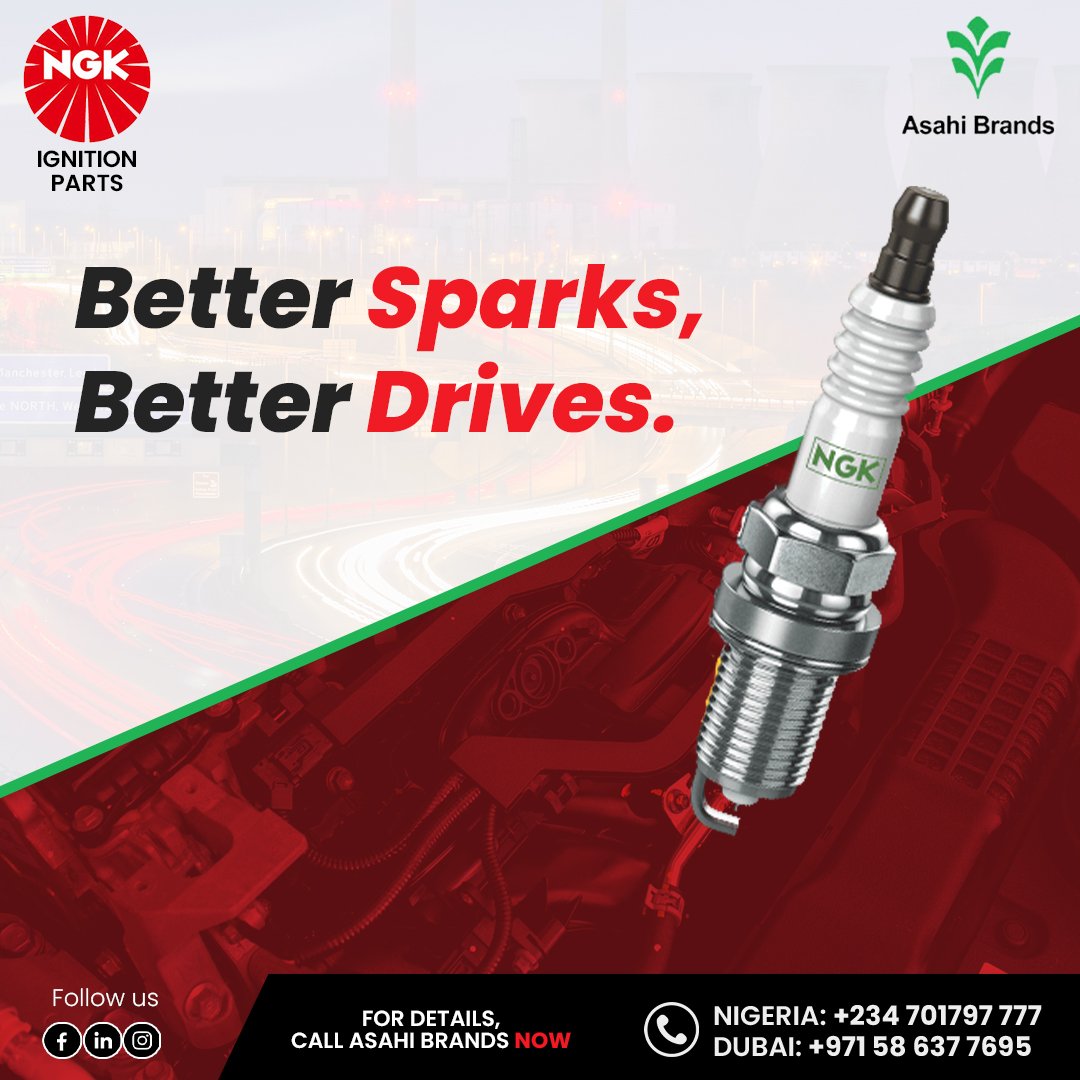
NGK Spark Plugs in Lagos: The Complete Guide to Ignition Performance, Fuel Efficiency, and Engine Reliability
Every combustion engine relies on a precisely timed spark to ignite the fuel-air mixture inside each cylinder, thousands of times per minute at highway speed. The component responsible for that spark, the humble spark plug, is easy to overlook until it starts failing, at which point its influence over engine performance becomes impossible to ignore. For Lagos drivers navigating heavy traffic, long commutes, and demanding commercial routes, understanding spark plug quality is one of the simplest ways to protect both engine health and fuel budget.
This guide explores how ignition systems work, the warning signs of failing spark plugs, the differences between spark plug types, and what to consider when sourcing genuine NGK spark plugs in Lagos. Asahi Brands Limited, a trusted importer, distributor, wholesaler, retailer, and supplier of genuine automotive parts in Nigeria, is referenced as an example of the kind of sourcing relationship worth establishing. Our catalogue can be viewed at https://www.asahibrands.com.
Understanding the Role of Spark Plugs in Engine Ignition
Inside a petrol engine, each cylinder undergoes a repeating cycle: air and fuel are drawn in, compressed, ignited, and expelled as exhaust. The spark plug’s job is to deliver a precisely timed electrical spark that ignites the compressed fuel-air mixture, driving the piston down and generating power. This happens with remarkable frequency, often several thousand times per minute per cylinder at typical driving speeds.
Because this process repeats so often, even small inconsistencies in spark quality compound quickly into measurable performance effects. A spark plug that fires slightly late, weakly, or inconsistently does not just cause a single missed combustion event; it disrupts the smooth, repeated cycle the entire engine depends on for efficient operation.
Reliable Engine Starting: Where Problems First Appear
One of the earliest signs of spark plug wear is difficulty starting the engine, particularly in humid conditions common along the Lagos coast or during the rainy season. Worn electrodes struggle to generate a strong enough spark to reliably ignite the fuel mixture on the first attempt, especially when the engine is cold.
Common Starting Symptoms Linked to Worn Spark Plugs
- Extended cranking time before the engine catches.
- Multiple attempts are needed to start, particularly in damp weather.
- A rough, uneven idle immediately after starting that only smooths out after a minute or two.
While starting problems can have several causes, worn or substandard spark plugs are among the most common and most affordable to rule out first.
Fuel Efficiency: The Hidden Cost of Poor Ignition
Fuel efficiency is directly tied to combustion efficiency. When a spark plug fires inconsistently, the engine’s control system often compensates by adjusting fuel delivery, frequently resulting in a richer mixture than necessary. Over time, this translates into measurably higher fuel consumption, a cost that accumulates significantly for high-mileage drivers and commercial fleets.
For a private car owner covering modest daily distances, the difference might mean a marginally higher weekly fuel bill. For a commercial driver covering hundreds of kilometres daily, or a fleet operating dozens of vehicles, the cumulative fuel cost of poor ignition performance across a year can be substantial, often far exceeding the cost of proactive spark plug replacement.
Engine Power and Acceleration
Weak or inconsistent sparks reduce the completeness of combustion within each cylinder, directly reducing the power generated per cycle. Drivers often describe this as a general sense that the vehicle “feels sluggish” or hesitates under acceleration, particularly when overtaking or climbing inclines. Because this decline is often gradual, many drivers adapt to it without realising how much performance has quietly been lost until fresh, correctly specified spark plugs are installed and the difference becomes immediately apparent.
Misfiring: A Warning Sign That Should Not Be Ignored
An engine misfire occurs when combustion fails to happen correctly in one or more cylinders. It can result from a spark plug that has degraded to the point of failing to fire reliably, or from a substandard plug that was never manufactured to consistent specifications in the first place.
Consequences of Ongoing Misfires
- Rough, uneven engine running, often felt as vibration through the cabin.
- Increased unburned fuel passing into the exhaust system, which can damage the catalytic converter over time, is a considerably more expensive repair than a spark plug.
- Reduced power output and inconsistent throttle response.
- Illuminated check engine warning lights, as the vehicle’s onboard diagnostics detect the irregular combustion pattern.
Persistent misfiring should always be investigated promptly, as the secondary damage it can cause to exhaust and catalytic components frequently costs far more than timely spark plug replacement would have.
Poor Acceleration and Rough Idling: Everyday Symptoms Lagos Drivers Notice
Given the stop-start nature of Lagos traffic, rough idling and hesitant acceleration are not abstract concerns; they are daily annoyances that also indicate underlying inefficiency. A vehicle that idles roughly at traffic lights or hesitates when pulling away is placing additional strain on its engine management system as it attempts to compensate for inconsistent combustion.
Spark Plug Replacement: Timing and Best Practice
Spark plugs are a scheduled maintenance item, meaning they should be replaced according to the vehicle manufacturer’s recommended interval rather than only when problems become noticeable. Waiting until symptoms appear often means the vehicle has already been running inefficiently, potentially causing secondary wear, for some time.
General Guidance on Replacement Intervals
Replacement intervals vary depending on the spark plug material and the vehicle manufacturer’s specifications, but as a general pattern:
- Standard copper-core plugs typically require more frequent replacement.
- Platinum spark plugs generally offer an extended service life compared to standard copper plugs.
- Iridium spark plugs typically offer the longest service life among common spark plug types, owing to the durability of the iridium electrode material.
Always confirm the correct interval and specification for your specific vehicle rather than relying on generalised assumptions, since engine design varies considerably between manufacturers and models.
Iridium vs Platinum Spark Plugs: Understanding the Difference
Iridium Spark Plugs
Iridium is an extremely hard, durable metal, allowing manufacturers to use a much finer electrode tip than traditional materials. This finer tip improves spark efficiency and, combined with iridium’s resistance to erosion, contributes to a considerably longer service life. Iridium plugs are often favoured in modern engines with tighter tolerances and higher performance expectations.
Platinum Spark Plugs
Platinum spark plugs offer a middle ground between standard copper plugs and iridium plugs, providing improved durability over copper at a typically more accessible price point than iridium. They remain a solid choice for many vehicles where the manufacturer does not specifically require iridium.
Choosing Between Them
The correct choice depends primarily on the vehicle manufacturer’s original specification rather than personal preference alone. Installing a spark plug type not intended for a specific engine design can, in some cases, lead to suboptimal performance even if the plug itself is genuine and well-manufactured.
Heat Range: A Frequently Misunderstood Specification
Every spark plug is designed within a specific heat range, referring to how quickly the plug dissipates heat from its tip. Using a plug with an incorrect heat range for a given engine can cause problems:
- A plug that runs too hot for the engine’s design may cause pre-ignition or knocking.
- A plug that runs too cool may accumulate carbon deposits, leading to fouling and misfires.
Manufacturer specifications exist precisely to match heat range to engine design, which is another reason genuine, correctly specified spark plugs matter more than generic substitutes chosen on price alone.
Ignition Performance Across Vehicle Types
Passenger Vehicles
For everyday drivers, correctly specified spark plugs mean smoother daily driving, more predictable fuel costs, and reduced risk of unexpected breakdowns caused by ignition failure.
Commercial Vehicles
Commercial vehicles covering high daily mileage place spark plugs under more frequent ignition cycles, making adherence to correct replacement intervals even more important. A commercial vehicle running on worn plugs not only consumes more fuel but risks more significant misfire-related damage given its higher usage intensity.
Preventive Maintenance: The Most Cost-Effective Approach
Reactive maintenance, waiting until symptoms force a repair, is almost always more expensive than preventive maintenance. Scheduling spark plug replacement according to manufacturer intervals, rather than waiting for misfires or starting problems to appear, protects the engine, the catalytic converter, and overall fuel efficiency simultaneously.
Choosing the Correct Spark Plug for Your Vehicle
Selecting the right spark plug requires attention to several factors:
- Manufacturer specification, including thread size, reach, and heat range.
- Engine type and performance characteristics, since some engines are specifically designed around iridium or platinum plugs.
- Driving conditions, as vehicles used primarily for stop-start city driving experience different ignition demands than those used for sustained highway travel.
- Genuine sourcing, ensuring the plug meets the exact material and manufacturing standards the engine was designed around.
The Counterfeit Spark Plug Problem
Because spark plugs are inexpensive relative to many other automotive components, they are sometimes overlooked as a counterfeiting target, but the problem is real. Counterfeit spark plugs may use inferior electrode materials, inconsistent gap specifications, or poor-quality insulation, all of which undermine ignition consistency in ways that are not visible without technical testing.
Signs to Watch For
- Inconsistent packaging quality or printing compared to verified genuine products.
- Prices are substantially below the normal market range.
- Absence of clear part numbers matching the vehicle manufacturer’s specification.
- Sellers are unable to confirm sourcing or provide purchase documentation.
Given how frequently spark plugs are replaced compared to larger components, buyers benefit significantly from establishing a relationship with a single trustworthy supplier rather than repeatedly sourcing from varied, unverified sellers.
The Relationship Between Spark Plugs and Emissions Compliance
While emissions testing is not yet uniformly enforced across every part of Nigeria, vehicle emissions remain a meaningful indicator of engine health, and spark plug condition plays a direct role in how cleanly an engine burns fuel. Incomplete combustion caused by worn or substandard spark plugs releases more unburned hydrocarbons into the exhaust stream, which not only contributes to environmental pollution but also indicates fuel that was paid for and never properly converted into useful engine power. For businesses increasingly conscious of operational efficiency and environmental responsibility, well-maintained ignition systems offer a straightforward, low-cost way to reduce both fuel waste and emissions simultaneously.
Recognising the Difference Between Spark Plug Issues and Other Ignition Problems
Spark plugs are only one part of a broader ignition system that also includes ignition coils, wiring, and, in older vehicles, distributor components. Because several ignition-related faults can produce overlapping symptoms, it helps to understand where spark plugs fit within this wider picture.
A Practical Diagnostic Sequence
- Inspect the spark plug condition first, since this is the most accessible and often most cost-effective starting point.
- Check ignition coil function if spark plugs appear healthy, but misfiring persists, as a failing coil can produce similar symptoms to a worn plug.
- Examine wiring and connections for corrosion or damage, particularly relevant in humid coastal conditions around Lagos.
- Consult a qualified technician with diagnostic equipment if symptoms persist after spark plug replacement, since modern engine management systems can often pinpoint the specific cylinder or component responsible for a misfire.
This sequential approach prevents the common mistake of replacing spark plugs repeatedly without success when the underlying fault actually lies elsewhere in the ignition system.
Spark Plugs and Seasonal Driving Patterns in Nigeria
Nigeria’s wet and dry seasons each create distinct ignition challenges worth planning around.
Dry Season
Sustained high temperatures during the dry season place additional thermal stress on spark plugs, particularly in stop-start traffic, where engine bay temperatures can climb significantly. Plugs already nearing the end of their service life are more likely to show symptoms during this period, as the added heat stress accelerates the effects of existing electrode wear.
Wet Season
Humidity during the rainy season can make marginal spark plugs more likely to produce hard starting or hesitant idling, since moisture in the air intake combines with an already weakening spark to reduce ignition reliability further. Vehicles that started reasonably well during the dry season sometimes reveal underlying spark plug wear once the rains begin, making pre-emptive replacement ahead of the wet season a sensible precaution for vehicles approaching their recommended service interval.
Cost Comparison: Proactive Replacement vs Reactive Repair
Considering the relative costs involved helps illustrate why scheduled spark plug replacement is one of the more financially sensible maintenance decisions available to vehicle owners.
Approach Typical Cost Profile Associated Risks
Scheduled replacement at manufacturer interval , Predictable, modest cost , Minimal
Reactive replacement after symptoms appear. Similar plug cost, plus diagnostic time. Possible catalytic converter damage from prior misfiring
Ignoring symptoms and continuing to drive. No immediate cost. Elevated fuel consumption, risk of expensive secondary damage
The comparison makes clear that the financial risk lies not in the cost of the spark plugs themselves, which remain modest, but in the secondary damage that can accumulate when replacement is delayed.
Why Choose Asahi Brands Limited?
Asahi Brands Limited operates as a trusted importer, distributor, wholesaler, retailer, and supplier of genuine NGK spark plugs and related ignition components, serving customers across Lagos and throughout Nigeria. Based at 122–132, Oshodi Apapa Expressway, Isolo, Lagos, the company supports passenger vehicle owners, commercial fleets, and independent workshops alike.
Reasons to source genuine NGK spark plugs from Asahi Brands include:
- Directly imported genuine stock, sourced from globally recognised manufacturers rather than uncertain intermediaries.
- National distribution, supporting customers beyond Lagos across the wider Nigerian market.
- Wholesale and retail availability, suitable for individual vehicle owners as well as workshops managing regular ignition maintenance for multiple vehicles.
- Fleet and commercial vehicle support, with consistent stock availability for high-turnover consumable items like spark plugs.
- Competitive pricing, without compromising on authenticity or performance.
- Professional customer guidance, helping buyers confirm the correct spark plug specification for their specific vehicle.
- Nationwide delivery, ensuring accessibility regardless of location.
- A long-standing commitment to genuine sourcing, supporting repeat customers who value consistency over one-off convenience.
Explore the full range of genuine NGK spark plugs and ignition components at https://www.asahibrands.com.
Frequently Asked Questions
How do I know if my spark plugs need replacing? Common signs include difficulty starting, rough idling, reduced acceleration, increased fuel consumption, and an illuminated check engine light. If several of these appear together, spark plugs are a reasonable first point of investigation.
Are iridium spark plugs worth the extra cost compared to standard plugs? For vehicles where the manufacturer specifies iridium, yes, since they typically offer longer service life and more consistent performance. For vehicles not designed around iridium plugs, the manufacturer’s original specification should still guide the decision.
Can worn spark plug damage other parts of my engine? Yes. Persistent misfiring caused by worn or poor-quality spark plugs can allow unburned fuel to damage the catalytic converter, a significantly more expensive repair than timely spark plug replacement.
How often should spark plugs be replaced in Nigerian driving conditions? This depends on the plug material and manufacturer specification, but high-mileage or stop-start driving common in Lagos may warrant checking intervals slightly more proactively than the manufacturer’s baseline recommendation for lighter usage patterns.
Conclusion
Spark plugs may be small, but their influence over starting reliability, fuel efficiency, engine power, and long-term engine health is significant and often underestimated. In a driving environment as demanding as Lagos, where stop-start traffic and long commutes place repeated ignition cycles on an engine daily, genuine, correctly specified spark plugs are one of the most cost-effective investments a vehicle owner can make.
For drivers, fleet operators, and workshops across Lagos and Nigeria seeking genuine NGK spark plugs, Asahi Brands Limited offers directly imported, authentic ignition components backed by professional guidance and nationwide delivery. Visit https://www.asahibrands.com to find the correct spark plugs for your vehicle and keep your engine running as it was designed to.




Write your review
No reviews yet. Be the first to review!