
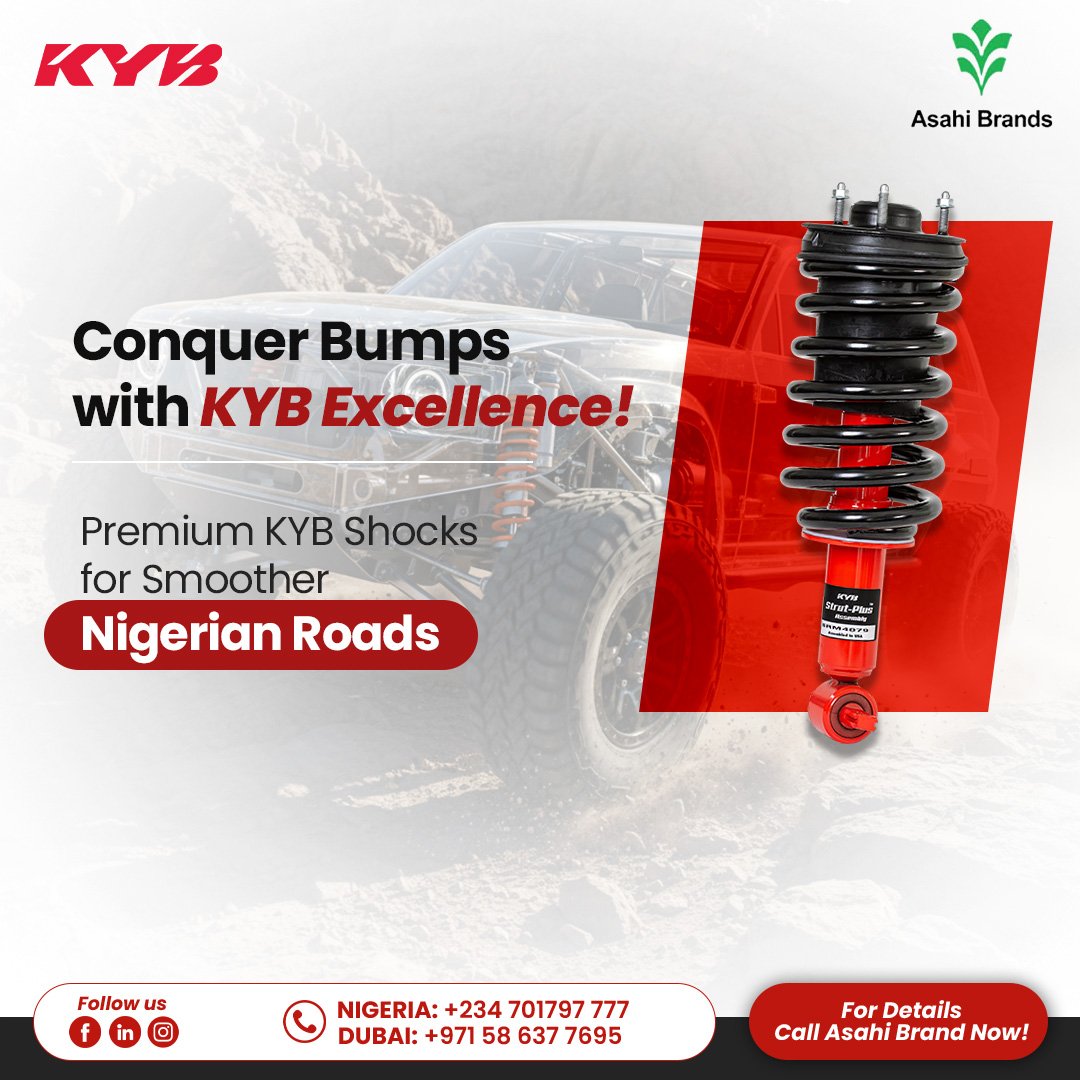
KYB Shock Absorbers in Lagos: Why Suspension Quality Determines Comfort, Control, and Safety
Suspension systems rarely receive the attention they deserve until something goes visibly wrong: an unusually bumpy ride, a car that leans excessively in corners, or a worrying vibration through the steering wheel. Yet the suspension system, and specifically the shock absorbers within it, plays a continuous, largely invisible role in keeping a vehicle stable, controllable, and safe, particularly on roads as demanding as those found across Lagos and much of Nigeria.
This guide explains how shock absorbers function, why Nigerian road conditions place unusual demands on suspension components, the warning signs of wear, and what to consider when sourcing genuine KYB shock absorbers in Lagos. Asahi Brands Limited, a trusted importer, distributor, wholesaler, retailer, and supplier of genuine automotive parts in Nigeria, is discussed as an example of the kind of supplier relationship that protects both safety and long-term value. Their catalogue can be explored at https://www.asahibrands.com.
What Shock Absorbers Actually Do
Many drivers assume shock absorbers exist purely for comfort, softening the impact of bumps and potholes. While comfort is certainly part of their function, their more critical role is controlling the movement of the vehicle’s springs, ensuring that after a wheel encounters a bump, it returns to and stays in contact with the road surface as quickly and consistently as possible.
Without effective shock absorption, a wheel that hits a bump can continue oscillating up and down for a noticeable period afterward, reducing the tyre’s contact with the road during that time. Since braking, steering, and acceleration all depend on tyre contact with the road surface, this has consequences that extend well beyond ride comfort.
Why Nigerian Roads Place Exceptional Demands on Suspension Systems
Road conditions across Lagos and much of Nigeria present a uniquely demanding environment for suspension components:
- Frequent potholes, some severe enough to cause sudden, sharp impacts rather than gradual undulation.
- Uneven road surfaces, including patched sections, drainage channel crossings, and speed bumps of inconsistent height.
- High ambient temperatures can accelerate the degradation of hydraulic fluid and rubber components within suspension systems.
- Heavy traffic congestion results in frequent low-speed manoeuvring that places repeated smaller stresses on suspension bushings and mounts.
These conditions mean that suspension components in Nigeria frequently experience more cumulative stress over a given period than the same components might experience in markets with smoother, more consistently maintained road networks. This makes component quality even more consequential locally than it might be elsewhere.
Vehicle Stability: The Foundation of Safe Driving
Stability refers to how predictably a vehicle behaves during normal driving manoeuvres: cornering, lane changes, and braking. Worn shock absorbers allow excessive body roll during cornering and excessive weight transfer during braking, both of which reduce a driver’s ability to predict and control the vehicle’s behaviour.
Practical Example
Consider a vehicle navigating a roundabout at a moderate speed. With healthy shock absorbers, the vehicle’s body remains relatively level, and all four tyres maintain consistent contact with the road, allowing predictable steering response. With worn shock absorbers, the vehicle may lean noticeably, shifting weight away from certain tyres and reducing the grip available exactly when it is needed most.
Ride Comfort: More Than Just Passenger Convenience
While comfort might seem like a secondary concern compared to safety, it has practical implications too. A harsh, bouncy ride increases driver fatigue over long journeys, and for commercial drivers covering substantial daily distances, cumulative fatigue can itself become a safety factor. Passengers, particularly on shared transport or fleet vehicles, also form lasting impressions of service quality based partly on ride comfort.
Steering Control: The Hidden Connection
Many drivers do not immediately associate steering feel with suspension health, yet the two are closely linked. Worn shock absorbers can cause a phenomenon sometimes described as “wheel hop” or excessive vibration through the steering wheel, particularly over rough surfaces. It not only reduces driving comfort but can genuinely compromise the driver’s ability to maintain precise steering input, particularly during emergency manoeuvres.
Road Handling on Nigerian Terrain
Handling refers to how a vehicle responds to driver input across varying conditions, from smooth expressways to heavily potholed side roads. Effective shock absorbers allow a vehicle to maintain composure across this range, transitioning between surface types without excessive body movement or loss of tyre contact.
Given how frequently Lagos drivers transition between well-maintained expressways and significantly rougher side streets within a single journey, suspension components are rarely given a chance to “settle” into one operating condition, making their consistency across varied conditions especially important.
Braking Stability and Suspension Health
Braking performance depends not just on the brake components themselves but on the suspension system’s ability to keep all four tyres in consistent contact with the road during the braking event. Worn shock absorbers can allow excessive nose-dive during hard braking, shifting weight forward, and reducing the rear tyres’ contact with the road, which can extend stopping distances and reduce overall vehicle stability during emergency stops.
Common Signs of Worn Suspension
Recognising the early signs of suspension wear allows for proactive replacement before the problem affects safety or causes secondary damage to other components.
Key Warning Signs
- Excessive bouncing after passing over a bump, rather than the vehicle settling quickly.
- The nose dived noticeably during braking.
- Uneven tyre wear, particularly patchy or cupped wear patterns.
- The vehicle is leaning excessively during cornering.
- Fluid leakage is visible on the shock absorber body itself.
- Unusual noises, such as clunking or knocking, over bumps.
- A generally harsher, less controlled ride compared to when the vehicle was new or recently serviced.
Any combination of these signs warrants a professional suspension inspection, ideally before a long journey or heavy load is placed on the vehicle.
Shock Absorber Replacement: Timing Considerations
Shock absorbers degrade gradually, which means many drivers adapt unconsciously to worsening performance without realising how much has changed until replacement components are installed and the improvement becomes immediately apparent.
General Replacement Guidance
While specific intervals vary by vehicle, usage pattern, and road conditions, shock absorbers are generally considered wear items that should be assessed regularly as part of routine maintenance, particularly for vehicles regularly exposed to Nigeria’s more demanding road surfaces. Vehicles used for commercial purposes, given their higher mileage and frequently heavier loads, typically warrant more frequent suspension inspection than lightly used private vehicles.
Suspension Considerations for Commercial Vehicles and Fleets
Commercial vehicles face compounded suspension demands: higher and more variable loads, more frequent daily mileage, and often less predictable route conditions than private vehicles. For fleet operators, proactive suspension maintenance offers particular value:
- Reduced risk of unplanned breakdowns caused by sudden shock absorber failure.
- More predictable ride quality, protecting cargo and, where relevant, passenger comfort.
- An extended tyre lifespan, since well-maintained suspension reduces uneven tyre wear.
- Improved braking stability under load, particularly important for vehicles carrying variable cargo weights.
Suspension Considerations for Passenger Vehicles
For private vehicle owners, maintaining suspension health protects daily comfort, supports safer emergency manoeuvring, and helps preserve tyre life, an often overlooked cost saving connected to good suspension maintenance.
Genuine KYB Shock Absorbers: Why Sourcing Matters
Shock absorbers are precision hydraulic components, relying on internal valving and fluid characteristics calibrated to specific vehicle weight, ride height, and intended use. Genuine KYB shock absorbers are manufactured to match these specifications closely, ensuring the component behaves as the vehicle’s suspension system was designed to expect.
Risks of Substandard Shock Absorbers
- Inconsistent damping performance, undermining both comfort and control.
- Premature internal wear, leading to fluid leakage and reduced effectiveness, well before expected service life.
- Incompatible valving characteristics can create an unpredictable ride feel that does not match the vehicle’s intended handling behaviour.
- Reduced structural durability under Nigeria’s demanding road conditions, where impact loads are frequently more severe than in smoother driving environments.
Suspension Safety: A Systemic Perspective
It is worth emphasising that suspension components rarely function in isolation. Shock absorbers work alongside springs, bushings, and mounts as a coordinated system. Installing a single high-quality shock absorber alongside worn bushings or degraded mounts will not deliver the full benefit the component is capable of providing. A comprehensive suspension inspection, rather than a narrow focus on shock absorbers alone, gives the most accurate picture of a vehicle’s overall suspension health.
Choosing a Reliable Supplier for Genuine KYB Products
When sourcing shock absorbers or broader suspension components, consider:
- Verified import sourcing, reducing the likelihood of counterfeit or substandard stock.
- Correct specification matching, since shock absorbers vary by vehicle model, trim level, and sometimes even production year.
- Availability for both individual and fleet purchasing needs.
- Support for professional installation guidance, given the importance of correct fitment for suspension components.
Suspension Wear and Tyre Economics
One of the less obvious consequences of worn suspension is its impact on tyre lifespan, an expense that many owners do not immediately connect to shock absorber condition. When a wheel loses consistent contact with the road due to inadequate damping, it can bounce or skip rather than roll smoothly, producing irregular wear patterns, sometimes described as cupping, across the tyre’s surface.
How This Plays Out in Practice
Consider a vehicle with worn rear shock absorbers driven regularly on a mixed route of Lagos expressway and heavily potholed side streets. Over several months, the rear tyres may begin to show a distinctive scalloped wear pattern, reducing their effective lifespan by a significant margin compared to tyres on a vehicle with healthy suspension. Since tyres represent a meaningful ongoing expense for any vehicle owner, particularly commercial operators replacing tyres across multiple vehicles, this connection between suspension health and tyre economics is well worth factoring into maintenance planning.
Suspension Inspection: What a Thorough Check Involves
Many drivers assume a suspension inspection means checking whether the shock absorbers are visibly leaking. A genuinely thorough inspection covers considerably more ground.
Key Elements of a Comprehensive Suspension Check
- Visual inspection of shock absorber bodies for fluid leakage or physical damage.
- Bounce testing, pressing down firmly on each corner of the vehicle and observing how quickly it settles.
- Bushing and mount inspection, checking for cracking, excessive play, or perished rubber.
- Tyre wear pattern assessment, since uneven wear often reveals suspension issues before other symptoms become obvious.
- Road test evaluation, assessing body control over bumps, cornering stability, and braking behaviour under real driving conditions.
A suspension inspection limited only to the first item on this list risks missing developing problems that a more comprehensive check would catch considerably earlier.
Load Considerations for Commercial and Passenger Vehicles
Shock absorbers are designed around expected load ranges, and operating a vehicle significantly outside its intended load parameters, whether through overloading a commercial vehicle or consistently carrying unusually heavy cargo in a passenger vehicle, accelerates suspension wear beyond what standard maintenance intervals anticipate.
Practical Guidance
- Commercial operators should factor typical cargo weight into suspension inspection frequency, checking more often if vehicles regularly operate near their maximum rated load.
- Passenger vehicle owners who frequently carry heavy loads, such as tradespeople transporting equipment or families regularly travelling with substantial luggage, should likewise consider more frequent suspension checks than the baseline manufacturer interval assumes.
Suspension Performance in Different Nigerian Driving Environments
Suspension demands vary considerably depending on where a vehicle primarily operates.
Urban Lagos Driving
Frequent stop-start traffic, speed bumps, and pothole-riddled side streets create repeated, smaller-scale stress on suspension bushings and shock absorbers, even without dramatic single impacts.
Inter-State and Highway Travel
Longer, sustained highway travel places different demands on suspension, particularly around maintaining stability at higher speeds and managing occasional larger road imperfections encountered along interstate routes.
Rural and Semi-Urban Roads
Vehicles regularly travelling less developed roads, common for agricultural or construction-related travel, face more frequent significant impacts, warranting more robust suspension components and closer monitoring for wear.
Why Choose Asahi Brands Limited?
Asahi Brands Limited operates as a trusted importer, distributor, wholesaler, retailer, and supplier of genuine KYB shock absorbers and suspension components, serving customers across Lagos and throughout Nigeria. Headquartered at 122–132, Oshodi Apapa Expressway, Isolo, Lagos, the company supports passenger vehicles, SUVs, commercial fleets, and workshops with reliable access to genuine suspension parts.
Reasons to choose Asahi Brands for genuine KYB shock absorbers include:
- Directly imported genuine stock, sourced from globally recognised manufacturers.
- Nationwide distribution, extending genuine parts access well beyond Lagos.
- Wholesale and retail supply options are suitable for individual vehicle owners and fleet operators alike.
- Dedicated fleet and commercial vehicle support, recognising the particular suspension demands faced by high-mileage operators.
- Competitive pricing, balanced against genuine quality assurance.
- Reliable inventory availability reduces pressure to source suspension components from unverified sellers during urgent repairs.
- Professional customer support, assisting buyers in confirming the correct specification for their specific vehicle.
- Nationwide delivery, ensuring accessibility across Nigeria.
Explore the full range of genuine KYB suspension products at https://www.asahibrands.com.
Frequently Asked Questions
How can I tell if my shock absorbers need replacing without a professional inspection? Watch for excessive bouncing after bumps, noticeable nose-diving under braking, uneven tyre wear, and a generally harsher ride than usual. These signs warrant a professional inspection, but they are useful early indicators that drivers can notice themselves.
Do Nigerian road conditions really wear out shock absorbers faster than elsewhere? Frequent potholes, uneven surfaces, and high ambient temperatures are common across much of Nigeria and place additional cumulative stress on suspension components compared to smoother, more consistently maintained road networks, making regular inspection particularly worthwhile.
Should shock absorbers always be replaced in pairs? Replacing shock absorbers on the same axle together is generally recommended to maintain balanced handling characteristics, rather than mixing a new component with a significantly worn one on the opposite side.
Can worn suspension affect fuel efficiency? Indirectly, yes. Reduced tyre contact and uneven wear caused by worn suspension can contribute to inefficient rolling resistance and irregular tyre wear patterns, both of which can influence fuel consumption over time.
Suspension quality is one of those aspects of vehicle ownership that goes largely unnoticed when everything is working correctly, and painfully obvious when it is not. Given the demanding nature of Lagos and Nigerian road conditions, genuine, correctly specified shock absorbers play a disproportionately important role in maintaining stability, comfort, steering control, and braking performance.
For vehicle owners, fleet operators, and workshops across Lagos and Nigeria seeking genuine KYB shock absorbers, Asahi Brands Limited offers directly imported, authentic suspension components backed by professional guidance and nationwide delivery. Visit https://www.asahibrands.com to find the correct suspension parts for your vehicle and restore the comfort, control, and safety your driving deserves.


Write your review
No reviews yet. Be the first to review!