
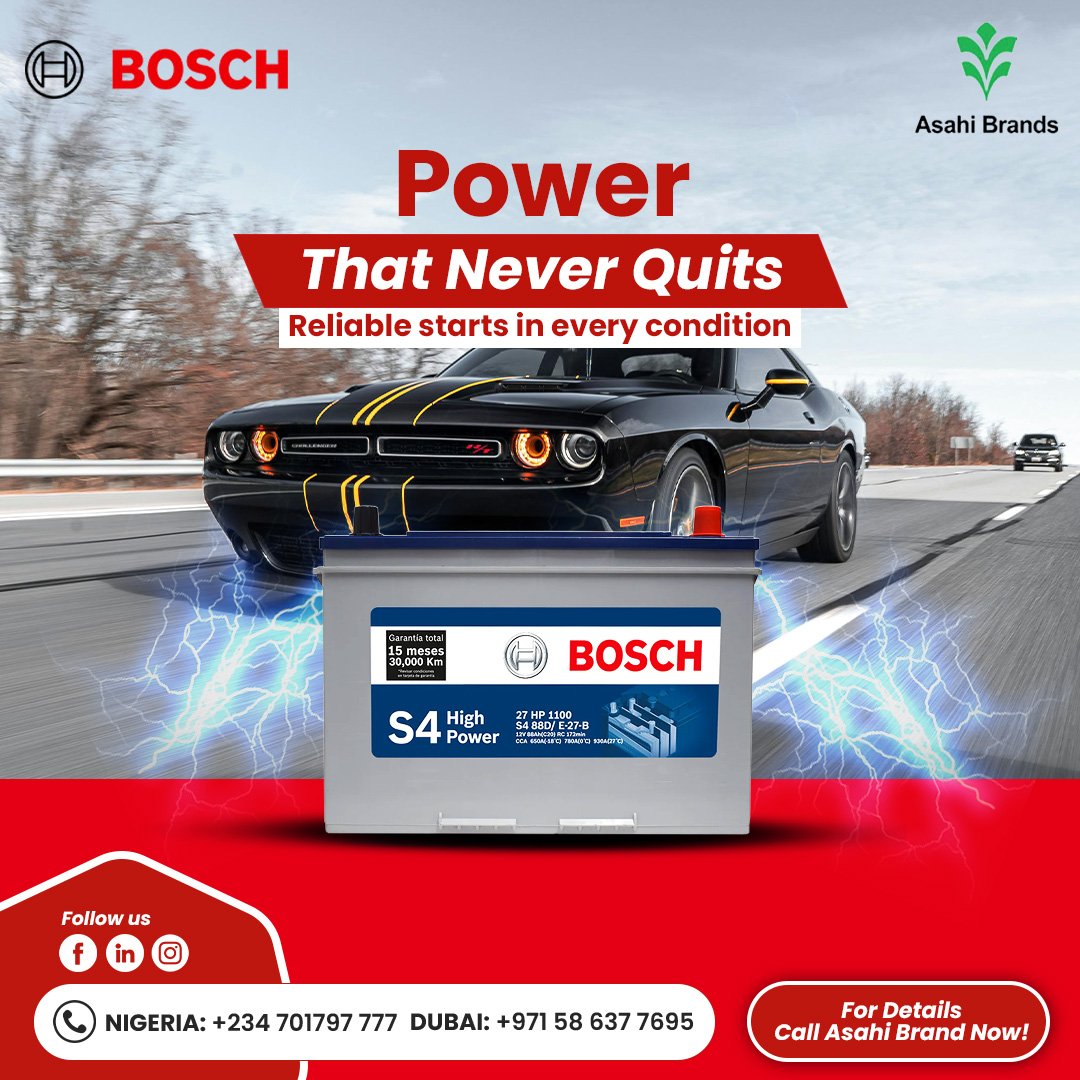
How Bosch Auto Parts Supplier Sets the Standard for Precision
What makes Bosch different from many aftermarket brands is the sheer scale of its role as an Original Equipment (OE) manufacturer. A significant share of the world’s leading vehicle manufacturers — including European, Japanese, Korean, and American marques commonly seen on Nigerian roads, such as Mercedes-Benz, Toyota, Volkswagen, Hyundai, Ford, and Peugeot — rely on Bosch as a direct supplier for braking systems, fuel injection components, starter motors, alternators, and batteries. When Bosch produces an aftermarket part, it is frequently manufactured on the very same production lines, to the very same specifications, as the part that left the factory installed in the vehicle.
Bosch’s manufacturing facilities operate under the IATF 16949 quality management standard — the automotive industry’s most rigorous certification — which mandates statistical process control, traceability of every batch of raw material, and continuous improvement protocols. For batteries, this means each cell undergoes capacity testing, cold-cranking performance verification, and vibration-resistance testing that simulates years of rough-road use in a matter of hours. For fuel injectors, it means each nozzle is flow-tested and calibrated to ensure the spray pattern, atomization, and delivered fuel volume fall within micron-level tolerances — because even a microscopic deviation in a diesel injector nozzle can alter combustion efficiency, increase emissions, and accelerate engine wear.
For Nigerian vehicle owners, this global legacy translates into something very tangible: a part that has already survived the harshest stress tests a German engineering lab can devise is far better equipped to survive the harshest stress tests a Nigerian road can devise — provided, of course, that the part installed under the bonnet is actually the genuine article, and not a counterfeit riding on Bosch’s good name.
The Nigerian Reality: Why Cheap Alternatives Fail Faster Here Than Anywhere Else
In most of the world, a “cheap” automotive part is a financial risk—it might wear out sooner than expected. In Nigeria, a cheap or counterfeit part is often a safety risk, and the timeline for failure is dramatically compressed by environmental factors that few imported “generic” components are designed to withstand.
1. The Heat Problem: Ambient temperatures across Lagos, Port Harcourt, and the wider south can regularly exceed 32–35°C, with under-bonnet temperatures climbing significantly higher once the engine is running. Battery electrolyte reacts to heat: every temperature rise accelerates the chemical breakdown of the plates and the evaporation of water from the electrolyte. A counterfeit or low-grade battery, often built with thinner lead plates and inferior separator material to cut costs, cannot withstand this thermal stress. What might be rated for a three-year service life in a moderate European climate can fail in Nigeria within six to twelve months.
2. The Harmattan Dust Problem: From late November through February, Harmattan winds carry fine Saharan dust across much of Nigeria, particularly in the North—Kano, Kaduna, and Abuja are especially affected. This dust is abrasive and electrically conductive in humid conditions. It infiltrates alternator housings, contaminates electrical connectors, and can cause premature wear in any component without properly sealed gaskets and connector housings. Genuine Bosch electrical components are designed with ingress protection ratings that account for dust and moisture intrusion; many counterfeit alternators and starter motors use substandard rubber seals that crack and shrink within months of exposure to dust and heat cycling.
3. The Pothole and “Go-Slow” Problem: Nigeria’s road infrastructure—particularly secondary roads connecting commercial hubs like Nnewi to Onitsha, or the inner roads feeding into Apo Mechanic Village in Abuja—is riddled with potholes that can be axle-deep after a heavy rain. Every pothole impact sends a shockwave through the suspension and braking system. Brake discs and calipers absorb enormous mechanical stress; cheap, poorly cast brake discs can develop micro-cracks or warp under this kind of repeated impact, leading to brake judder, reduced stopping power, and—in the worst cases—catastrophic failure on a downhill stretch in heavy traffic. Heavy “go-slow” traffic compounds this. Stop-and-go driving in Lagos traffic means the braking system is engaged far more frequently than in normal highway driving, generating sustained heat in the braking components. Low-quality brake pads with inferior friction compounds can experience “brake fade”—a dangerous loss of stopping power—when subjected to this kind of repeated thermal cycling.
4. The Fuel Adulteration Problem: Perhaps the single most damaging factor for fuel injection systems in Nigeria is fuel quality. Adulterated or contaminated diesel and petrol—sometimes cut with kerosene, sometimes containing water or particulate contamination from poorly maintained storage tanks—wreak havoc on modern high-pressure common rail diesel systems. The injector nozzles in these systems operate with clearances measured in microns; a single grain of contamination can score the precision-ground internal surfaces, causing leakage, poor atomization, and a cascade of issues, including rough idling, loss of power, excessive smoke, and eventual injector failure. Counterfeit injectors, often built with softer metals and less precise machining tolerances, fail even faster under this kind of contamination because they have far less margin for error to begin with.
The combined effect of these four factors—heat, dust, road shock, and fuel quality—means that Nigeria is, in engineering terms, one of the most demanding operating environments on earth for automotive components. A part that is “good enough” for a European city is often nowhere near good enough for the Lagos–Ibadan corridor. It is precisely why genuine Bosch parts, engineered to exceed baseline specifications with significant safety margins, consistently outperform generic alternatives in real-world Nigerian conditions.
Technical Product Breakdown: Bosch Batteries, Injectors & Braking Systems
Bosch Automotive Batteries: S4, S5, and S6 Ranges
Bosch batteries are organized into performance tiers, each calibrated for different vehicle demands:
Battery Range Technology Best Suited For Key Feature
S4 Conventional flooded lead-acid (calcium-calcium grid) Standard passenger cars without stop-start Maintenance-free design, robust vibration resistance
S5 Enhanced flooded battery (EFB) Vehicles with basic stop-start systems, higher electrical loads , improved cycling durability, higher cold-cranking amps
S6 Absorbent Glass Mat (AGM) Premium vehicles, full stop-start, regenerative braking Sealed construction, vibration-proof, deep-cycle capability
Construction details that matter in Nigeria:
- Calcium-Calcium Grid Technology: Bosch S4 and S5 batteries use a calcium alloy for both the positive and negative plate grids. It significantly reduces water loss through electrolysis compared to older antimony-based designs, which matters enormously in a hot climate where water evaporation is already accelerated.
- PowerFrame Grid Technology: A radial grid structure that improves the distribution of electrical current across the plate, reducing internal resistance and improving both starting power and longevity under repeated deep-discharge cycles—common in Nigeria, where vehicles often sit with accessories running during long traffic delays.
- Reinforced Casing: Bosch battery casings are designed to withstand vibration testing equivalent to thousands of kilometers of rough-road driving, directly relevant to potholed routes in and around Lagos and the South-East.
- Cold Cranking Amps (CCA): While “cold” cranking is less of a concern in Nigeria’s climate, CCA rating is actually a strong proxy for the overall robustness and reserve capacity of a battery—a high-CCA Bosch battery has more “buffer” against the heat-accelerated capacity loss that affects all batteries operating above 30°C.
- AGM (S6) Technology: In AGM batteries, the electrolyte is absorbed into a fiberglass mat separator rather than existing as free liquid. It makes the battery spill-proof, more resistant to vibration damage, and capable of much deeper discharge cycles—ideal for modern SUVs and executive saloons increasingly common in Abuja and Lagos with heavy onboard electronics (infotainment, multiple ECUs, dash cameras, inverters).
Bosch Fuel Injection Systems: Common Rail Diesel & Petrol Injectors
Bosch pioneered the modern Common Rail Direct Injection (CRDI) system, now used in the majority of diesel pickups, SUVs, and commercial vehicles on Nigerian roads—including popular Toyota Hilux, Ford Ranger, and various commercial van and bus platforms used by logistics operators between Lagos, Port Harcourt, and Kano.
Key technical characteristics of genuine Bosch diesel injectors:
- Operating Pressure: Modern Bosch common rail systems operate at injection pressures that can exceed 1,800–2,000 bar, among the highest in the industry. Under these pressures, the precision of the injector nozzle is paramount; internal components are manufactured and matched to tolerances measured in single-digit microns.
- Piezo and Solenoid Valve Technology: Bosch injectors use either piezoelectric actuators (which expand and contract in response to electrical voltage with extremely fast response times) or advanced solenoid valves, both of which allow for multiple injection events per combustion cycle—pilot injection, main injection, and post-injection—improving fuel atomization, reducing knock, lowering emissions, and improving fuel economy.
- Nozzle Hole Geometry: The spray holes in a Bosch injector nozzle are laser-drilled and precisely shaped (often with a slight conical profile) to optimize the fuel spray cone angle and droplet size for the specific combustion chamber design—this directly affects how completely fuel burns, which in turn affects both power output and exhaust smoke.
- Material Composition: Injector bodies and needle valves are manufactured from hardened, high-grade steel alloys that resist erosion from fuel flow and are coated to reduce friction and wear, critical when operating with the variable fuel quality found across Nigerian filling stations.
- Petrol (Gasoline) Direct Injection: For modern GDI petrol engines (increasingly common in newer Toyota, Hyundai, and Kia models imported into Nigeria), Bosch injectors are designed to deliver precisely metered fuel directly into the combustion chamber at pressures up to several hundred bar, with multi-hole nozzle designs that ensure even fuel distribution for cleaner combustion and better fuel economy—a major consideration given the price of petrol in Nigeria.
Bosch Braking Systems: Pads, Discs, and ABS Components
- Friction Material Compounds: Bosch brake pads are available in multiple friction compounds—including low-metallic and ceramic-enhanced formulations—engineered to balance stopping power, noise reduction, pad longevity, and minimal disc wear. For Nigeria’s stop-start traffic conditions, this balance is critical: a pad that generates excessive heat during sustained braking (common in Lagos traffic) can “fade,” while a pad that is too aggressive will wear down brake discs prematurely.
- ECE R90 Certification: Genuine Bosch brake pads and discs sold as replacement parts in many markets meet ECE R90—a stringent European regulation requiring that aftermarket brake components match the performance of original equipment in terms of stopping distance, pedal feel, fade resistance, and wear rate. This certification is a meaningful differentiator from uncertified generic pads, which may have wildly inconsistent friction coefficients.
- Brake Disc Design: Bosch brake discs are precision-cast and machined to tight thickness and run-out tolerances, with many designs incorporating internal ventilation channels (for front discs on larger vehicles) that improve heat dissipation—directly relevant to Nigeria’s heavy traffic braking cycles. Discs are also often coated to resist the corrosion that can develop rapidly in humid coastal cities like Port Harcourt and Lagos.
- ABS Wheel Speed Sensors: Bosch, as the inventor of the modern ABS, manufactures wheel speed sensors with sealed housings designed to resist water, mud, and dust ingress—directly relevant to vehicles regularly driven through flooded streets during Nigeria’s rainy season. A failed or counterfeit ABS sensor can trigger dashboard warning lights, turn off ABS and traction control functions, and in some vehicles, affect the operation of electronic stability programs entirely.
Counterfeit Detection Guide: How to Spot Fake Bosch Parts in Nigeria’s Open Markets
Counterfeiting of premium automotive brands is a significant problem in markets across West Africa, and Bosch—given its global reputation—is among the most frequently counterfeited automotive brands. Here is how to protect yourself:
- 1. Check the Holographic Security Label: Genuine Bosch packaging for batteries, injectors, and braking components typically includes a holographic security label with a unique serial number. When tilted, a genuine hologram displays a shifting color pattern and fine micro-text that is extremely difficult to replicate. Counterfeit holograms often appear flat, blurry, or show a generic shimmer without the layered detail of the original.
- 2. Verify Packaging Print Quality: Genuine Bosch packaging uses high-resolution printing with consistent color saturation, sharp logo edges, and correctly aligned text. Counterfeit boxes frequently show slightly blurred logos, color that appears “washed out” or overly saturated, fonts that don’t quite match Bosch’s official typeface, or spelling errors in technical specifications.
- 3. Use Official Verification Tools: Bosch has implemented digital authentication systems for many of its automotive parts, allowing buyers to scan a QR code or enter a code via SMS or an authentication website to verify a product’s authenticity directly with the manufacturer. If a seller cannot provide a code that verifies successfully—or refuses to let you check before purchase—treat this as a serious red flag.
- 4. Inspect the Part Itself: For batteries, check that terminal posts are correctly sized, cleanly cast, and free of rough edges or excess flash from the molding process—genuine Bosch batteries have very clean, precise casing seams. For injectors, genuine Bosch components carry laser-etched part numbers and date codes that are crisp and uniform; counterfeit injectors often have stamped or engraved numbers that look hand-applied or inconsistent in depth and spacing. For brake pads, check for the ECE certification mark stamped into the steel backing plate—its absence, or a poorly stamped version of it, is a strong indicator of a non-genuine product.
- 5. Weight and Material Feel: Counterfeit batteries are frequently lighter than genuine equivalents because they use thinner lead plates or partially filled lead components to reduce material costs—if a battery feels suspiciously light for its rated capacity, be cautious. Similarly, counterfeit brake pads often feel lighter and may even produce a slightly different sound when tapped, due to lower-density friction material.
- 6. Buy Only from Verified Sources: Ultimately, the most reliable defense against counterfeits is the source itself. A retailer or wholesaler that operates as a direct importer with documented supply chains—like Asahi Brands—has every incentive to ensure the parts on their shelves are genuine, because their entire business model depends on that reputation. Open-market stalls operating without traceable sourcing cannot offer the same assurance, regardless of how convincing their packaging may look.
Your vehicle is one of the most significant investments you’ll make, and in Nigeria’s demanding driving conditions—punishing heat, Harmattan dust, brutal potholes, relentless traffic, and unpredictable fuel quality—every component matters. Genuine Bosch batteries, fuel injectors, and braking systems represent over a century of German engineering excellence, built with the precision tolerances and material quality needed to actually survive these conditions, not just technically “fit” your car.
Visit your nearest Asahi Brands retail outlet or Asahi Tyre Zone branch today to purchase certified genuine Bosch parts with a full manufacturer's warranty. Fleet operators, mechanics, and bulk buyers across Lagos, Abuja, Port Harcourt, Kano, and Nnewi can contact the Asahi Brands wholesale distribution desk directly to set up a reliable supply account. Protect your engine, protect your brakes, and protect yourself—insist on genuine Bosch, sourced through Asahi Brands.

Write your review
No reviews yet. Be the first to review!